
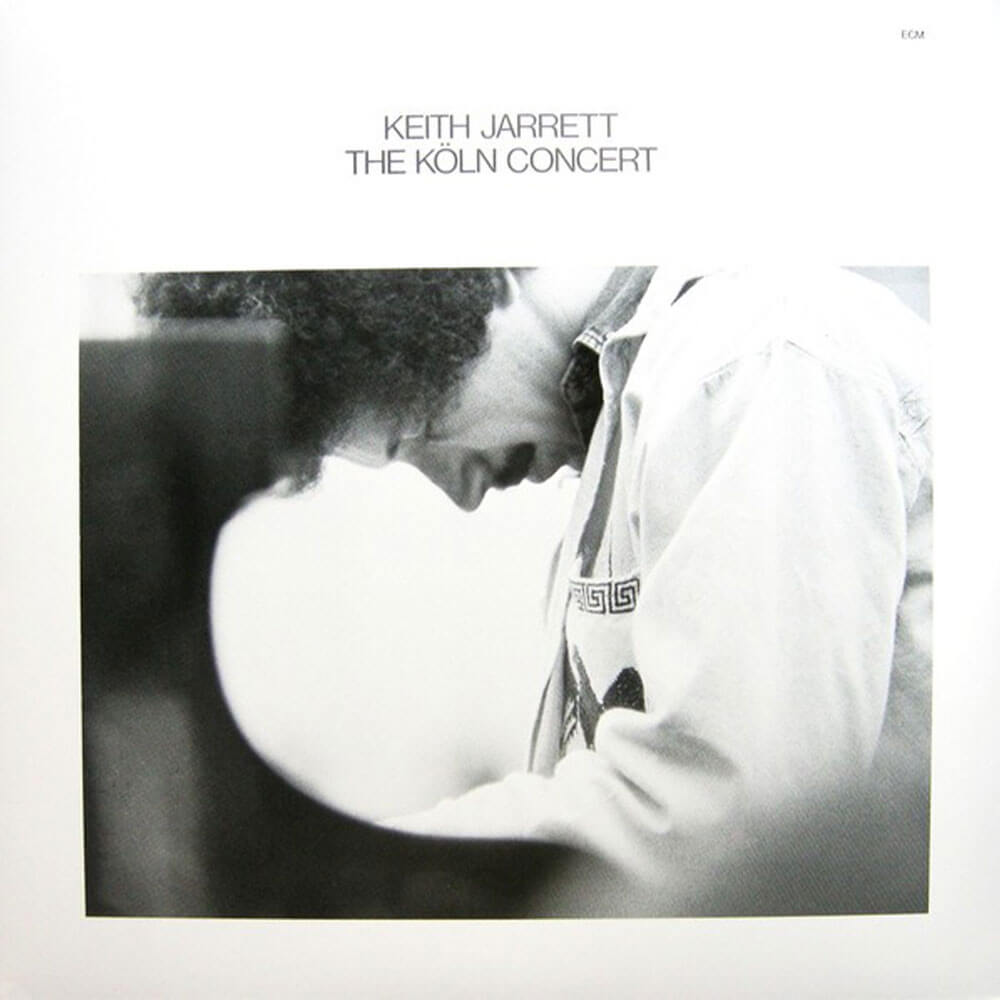
Keith Jarrett – The Köln Concert (1975)
By George Moraitis
| Label: | EMC Records |
|---|---|
| Genre: | Jazz |
| Style: | Post Bop, Free Improvisation |
| Released: | 1975 |
There are albums that succeed because everything goes according to plan and there are albums that become immortal because absolutely nothing does.
The Köln Concert occupies a unique place in recorded music. It is not merely the best-selling solo piano album in history – it is perhaps the greatest testament ever captured to artistic resilience, spontaneity and the mysterious relationship between adversity and creativity. Fifty years after its release, it still sounds less like a performance than an act of survival transformed into beauty. The circumstances surrounding the recording have become almost mythological, though they are entirely true.
By January 1975, Keith Jarrett was already recognised as one of the most gifted improvisers in jazz. He was twenty-nine years old, exhausted from touring, suffering from severe back pain and running on very little sleep after a long drive to Cologne. The concert itself had been organised by Vera Brandes, an eighteen year old concert promoter whose determination would prove every bit as important as Jarrett’s inspiration.
Upon arriving at the opera house, Jarrett discovered that the piano he had requested was not there.
Instead, waiting backstage was a small rehearsal piano, a Bösendorfer that was never intended for concert use. It was worn, underpowered and mechanically compromised. The bass register was muddy and weak, the upper octaves thin and brittle and several notes were out of tune. The sustain pedals were problematic and the instrument struggled to project into the large hall.
Jarrett reportedly refused to perform.
One can hardly blame him. He was tired, physically uncomfortable and had travelled to play an entirely improvised recital on an instrument incapable of delivering the sound palette he normally relied upon. For a musician whose performances depended upon nuance, touch and dynamic range, it was akin to asking a painter to work with half the colours removed from the palette.
Yet somehow, after persuasion from Brandes and with an audience already assembled, he agreed to go on stage.
And then something remarkable happened.
Rather than fighting the piano’s deficiencies, Jarrett adapted to them.
Unable to rely on the instrument’s weak lower register, he developed powerful left-hand ostinatos and rhythmic patterns that reinforced the missing bass frequencies. The limited sustain encouraged repeated figures, hypnotic vamps and rolling motifs that became foundational elements of the performance. The harsh upper register was avoided or carefully managed, leading Jarrett toward a warmer middle range where the piano retained some character and resonance.
What could have been a compromised recital instead became a masterclass in creative problem-solving.
Listening today, one hears not perfection but negotiation.
Every phrase feels like a conversation between artist and instrument. Jarrett discovers ideas in real time, tests their limits, abandons them, returns to them and reshapes them. The music unfolds with an extraordinary sense of inevitability, despite being entirely invented in the moment.
Part I is breathtaking in its architecture. What begins tentatively evolves into expansive melodic statements, gospel-inflected harmonies, meditative passages and propulsive rhythmic grooves that seem to emerge from nowhere. There are moments where Jarrett appears to stumble upon a motif and then suddenly realise its possibilities, nurturing it until it blossoms into something transcendent.
The shorter sections in Part II provide a different perspective. There is lyricism, introspection and an almost pastoral quality that occasionally hints at European classical traditions as much as American jazz. Throughout the performance, Jarrett’s gift for melody remains astonishing. Even though everything is improvised, much of the music possesses the emotional directness and memorability of carefully composed themes.
And then there are the sounds.
Jarrett hums, grunts, sighs and vocalises throughout the performance. In many recordings these noises might be considered distractions but here they feel inseparable from the music itself. They are evidence of total immersion, physical manifestations of thought becoming sound. He is not presenting a finished object to an audience; he is allowing listeners to witness creation as it occurs.
There is something profoundly moving about that vulnerability and it really affects me when I listen to this record.
Modern musicians often perform under immense pressure to appear flawless. Studio recordings can be edited endlessly, mistakes removed and imperfections polished away. The Köln Concert stands as a reminder that some of the most enduring art emerges precisely because imperfections remain visible.
One hears fatigue.
One hears determination.
One hears a musician confronting an instrument that does not cooperate and deciding, somehow, to make it sing anyway.
That may explain why The Köln Concert continues to resonate beyond the jazz community. It is not simply admired; it is loved. Listeners respond not only to its beauty but to the humanity embedded within it. The album documents a person overcoming disappointment, discomfort and limitation through imagination and instinct.
Had the correct piano arrived, perhaps Jarrett would have delivered a technically superior recital.
It is difficult to imagine he would have produced this recital.
What survives on record is an extraordinary paradox: a performance defined by constraints that became liberating, an imperfect instrument that inspired perfect adaptation, and an artist so completely absorbed in the act of creation that he ceased to care about appearances, expectations or even propriety.
The sounds he makes at the keyboard are not affectations.
They are evidence that, for seventy minutes in Cologne, Keith Jarrett disappeared entirely into the music.
And perhaps that is why The Köln Concert still feels so alive. It does not document mastery over circumstances. It documents mastery despite them.
Few recordings have ever sounded so human.