
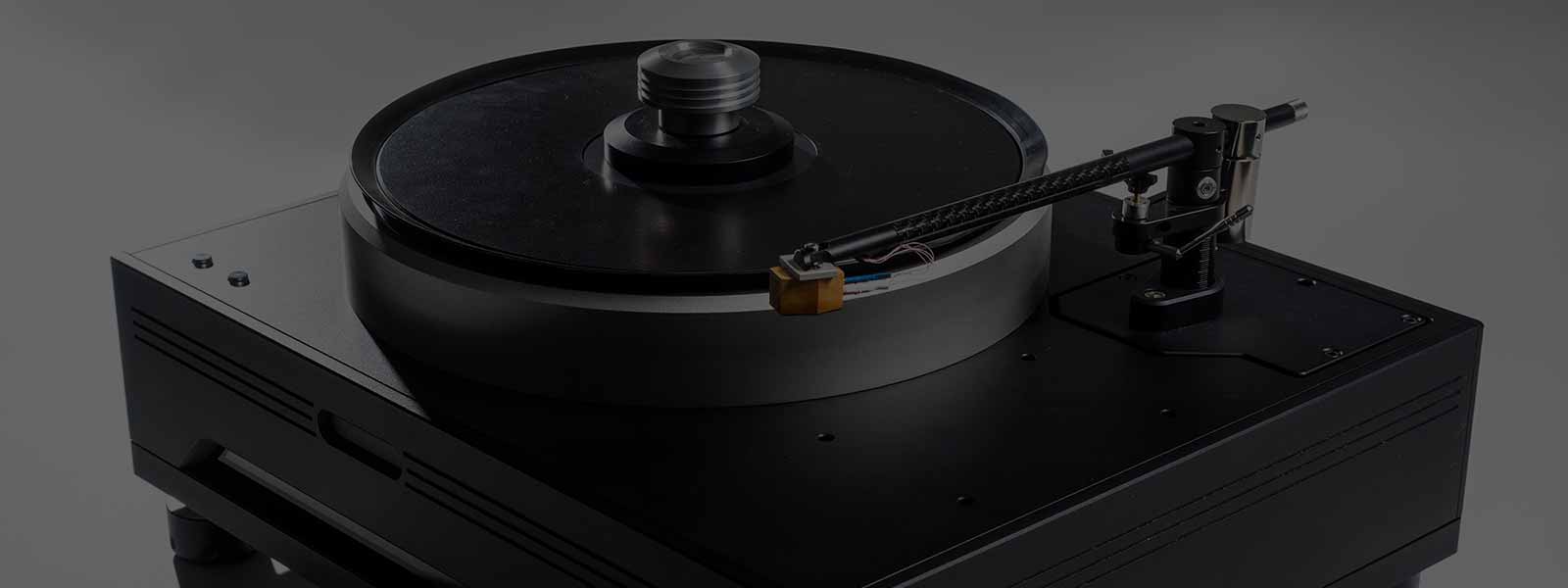
What does a vacuum hold-down system do?
A vacuum turntable uses a gentle suction beneath the record to draw the vinyl firmly and uniformly onto the platter surface. For this to work, the platter must have a special design: an air channel or pathway and a sealing mat or lip around the edge that allows the vacuum to create a seal under the record. Once the vacuum is engaged, the vinyl becomes effectively part of the platter — fully “coupled” and flat, eliminating air gaps and ensuring full-surface contact. This pressure is evenly spread across the whole disc, not just at the label/spindle area (as with a clamp) or edge (as with some stabiliser rings). Aside from presenting a flat vinyl record, the vinyl and the platter present as one ‘effective mass’, which has sonic benefits.
What are the sonic benefits of a well-designed vacuum hold-down system?
Eliminates warps and air gaps
A vacuum hold-down system forcibly flattens the record against the platter, whether the vinyl is slightly warped, has uneven pressing or simply isn’t perfectly flat. This ensures the stylus rides the grooves with consistent geometry. This can help avoid groove mis-tracking, distortion, or pitch instability that might otherwise result from warps or uneven contact. Because the entire surface is in intimate contact, you avoid “air pockets” under the record that might introduce resonance or micro-flutter.
Better stylus tracking and groove contact
With the record held perfectly flat and flush, the stylus can maintain consistent contact with the groove walls and floor, which improves tracking accuracy. This helps especially with delicate groove passages, subtle dynamics, and complex recording mixes, where even slight variations in contact can smear or blur detail. Also, because vacuum hold-down distributes force over the entire disc, it avoids some of the potential downsides of clamps (which only press at center) or weights (which increase inertia but may not flatten warped records completely).
Reduces resonance, vibration & feedback loops
Analog playback is highly sensitive: as the stylus tracks the groove, it generates tiny vibrations. Those vibrations can travel from the vinyl to the platter, bearing, and even into the tonearm or plinth — potentially feeding back into the stylus and muddying detail. By rigidly coupling the vinyl to the platter, the vacuum system reduces the chances for micro-movements and resonance, minimising energy interplay between the stylus and platter. This means fewer distortions, less “smearing,” and a more stable, accurate reproduction of the groove’s fine details.
More consistent speed & stability (less wow/flutter noise)
Once the record is tightly coupled to the platter, there’s less likelihood of slippage or micro-variations in rotation, both of which can cause wow and flutter (subtle pitch fluctuations) or timing instability. A vacuum system results in a minimal increase in rotational inertia compared to heavy weights, meaning less strain on the motor and platter bearing, yet you gain improved rotational stability.
Increase in sonic clarity, detail and accuracy
The overall improvement of superior stylus contact, reduced micro-vibrations and the elimination of warps/air gaps is less resonance and fewer mechanical anomalies. This allows the stylus to convert the groove geometry into an electrical signal more accurately. Discerning listeners report fewer distortions or colorations, which often improves midrange purity and clarity of vocals and instruments. Tighter bass, greater low frequency clarity, improved transient impact (drums, percussion), more image stability and better overall fidelity.

Why have we delayed offering our customers this feature?
Mark Dohmann has been building turntables since 1982 and has a lot of experience designing and building vacuum hold-down systems. When Dohmann Audio started the Helix project in 2013, Mark designed the Helix One and the Helix Two from the beginning with the vision to incorporate a vacuum system in the future. The architecture of the Helix platform has always had accommodations for a vacuum system and we have been quietly working away on a vacuum hold-down system with the intention of introducing it when we felt that it would represent value to our customers.
As our research & development progressed in the ensuing years, we were able to bring the operating noise floor of our turntables to unprecedented low levels. Due to advances in materials science, engineering, manufacturing technologies and test equipment technology, the Mk3 generation of turntables in particular are operating with noise floors that would have been considered impossible a few years ago. This rapid technological development posed a problem for incorporating a vacuum hold-down system. The reason is that traditional vacuum systems are relatively unsophisticated systems that contribute noise and various sonic artefacts to the playback performance. They are also traditionally unreliable, require onerous maintenance and in high resolving systems, can be heard operating during music playback. The lower we dropped our operating noise floor, the harder it became to incorporate a vacuum system that did not interfere with the playback performance and did not suffer from the traditional vacuum system issues.
We realised that to satisfy those customers who desired a vacuum hold-down system in our turntables, we had to go back to the drawing board and design something completely different to what has been used in the past. Mark consulted with the industrial manufacturing industry and researched the most advanced vacuum systems used in this sector. He found a new way of applying these technologies to the ecosystem of a turntable. The result is an advanced Rotary Feedthrough Technology using ‘shaped oil’ virtual o’ring seal technology to protect the rotating shaft and platter from air leaks. It has taken us a few years to create a version of this technology that can be used in audio reproduction but the wait has been worth it. The Dohmann vacuum hold-down technology is revolutionary in that it has never appeared in turntable applications before and it is so far advanced from existing vacuum designs that we now feel comfortable to introduce it as an option to our customers.
Finally, a vacuum system which is completely operationally sonically INVISIBLE and highly reliable, resulting in a positive ownership experience with elevated performance benefits.
Our design objectives
- Zero pump running during playback to reduce the pulsation signature of pumps to absolute minimum (a pump being off cannot pulsate).
- Minimal leakage of vacuum negative pressure during playback cycle (up to 30 minutes) so the record is held down through the entire playback cycle.
- Extended period of vacuum hold down to prevent a record lifting off the platter surface during playback.
- No complicated hose docking and pump cycle procedure to recharge the vacuum negative pressure.
- Low maintenance design with high reliability components proven in tough industrial environments.
- Fast vacuum pull down for quick LP grab and hold.
- Calibrated computer-controlled vacuum negative pressure for ease of operation.
- Ultra-low friction bearing design.
- Seal the rotary feedthrough from outside air ingress during playback.
- Self-cleaning and self-priming pump.
- Ultra-low pump noise and vibration signature during charge cycles.
- Pump Box able to sit on the same stand the turntable is placed upon (no need for remote mounting).
- Simple intuitive operation and clean minimal hose and power management.
Our design architecture
- Advanced Rotary Feedthrough Technology using “shaped oil” virtual o’ring seal technology to protect the rotating shaft and platter from air leaks.
- Bearing seals are ultra-low friction using special vacuum oil proven in the engineering field (where the need to maintain vacuum in chambers and allow rotational pathways into the vacuum chamber is critical).
- Bearing cooling technology that draws frictional heat away from the bearing housing under operation.
- Advanced computer-controlled logic that monitors multiple sensors and actively controls operational performance and vacuum cycles.
- Extended life pump design by reducing pump operational time to seconds per play. This non-running during playback pump architecture ensures the high reliability pump can reach 25+ year operational lifespans.
- Modular design for ease of servicing.
- Highest quality Pneumatic and Vacuum components which are proven in the most demanding industrial environments.
- Automated recovery cycles once LP playback is stopped (during LP record change procedures).

The benefits of our design
- Quietest vacuum pump available.
- Vacuum pump is off during playback.
- Over-sized auxiliary reservoir provides many litres of vacuum negative pressure, easily allowing for more than 30 minutes of pump-free vacuum operation.
- Only vacuum system in audio to use rotary feedthrough technology.
- ‘Virtual o-ring’ design inside the rotating bearing results in no added friction to an already extremely low friction design.
- High reliability operation results in life cycle extended to multiples of decades.
The Dohmann vacuum system explained
The Helix Vacuum system uses the most advanced technical solutions to achieve a noiseless vacuum hold down playback operation for your LP records. Vacuum hold down offers the best vinyl to platter interface by removing airgaps and warps. Placing the LP on a vacuum platter reduces warp wow artifacts to extremely low levels thus preserving the best path for stylus tracing of the microgroove.
One of the main challenges of a vacuum system is vacuum pump cyclic pulsation energy transferring along the tube/hose to the bearing system, allowing vibration to enter into the path for playback. A quick check of a running pump pulsation can reveal this vibration to the ear. If you apply the appropriate test equipment to the system, even the quietest pumps available have a considerable energy signature. It is an intermodulation to the source material and whilst it can be reduced in severity by complex methods it can only be fully removed by turning the pump off.
Pump technology for low noise operation includes scroll, bellows, diaphragm, pinched tube and other cyclic designs. Commonly available “fish tank” pumps are often seen in turntable designs as the vacuum turntable has been in the market since the 1950’s. These pumps use oscillating mechanisms and sometimes a flap of compliant material to open and close a valve to prevent air from moving between evacuated chambers. All these designs create some form of noise and vibration. Complex housings can be used to minimise the noise to the outside. However, the tube connecting the pump to the area to be vacuumed will still transmit the pulsing and operational noise.
Dohmann Audio have designed a pump technology and architecture which turns the pump off during playback. This idea is not new. Since the 1960’s companies such as Luxman Corporation from Japan and Thorens from Switzerland had systems which used a manual pump to evacuate the area under the LP by means of a docking hose and external manual operated pump. Audio Technica, another famous Japanese company in fact sell an aftermarket add on vacuum mat for low relative cost and use this same docking hose principle. These designs were plagued with irregular operation issues where the LP would prematurely release and cause the record to lift on the lip seal during playback. The user would not be able to recharge the system during playback as the valve would be spinning at the periphery of the platter.
These designs hope that once the record is sucked down the hose is disconnected and a one-way valve on the platter perimeter seals the vacuum that the area to hold vacuum (being quite small) would suffice to last the entire record side. Some recent concepts have added extra chambers inside the platter which can help reduce “premature ejection”.
So, what has Dohmann Audio done that is different? Well, the Helix design has recruited the best available technology from other industries where rotary feedthroughs are required to preserve vacuum chambers and allow torque to be transferred between vacuum and non-vacuum sides. To accomplish this in a record player requires the bearing to be sealed. Using a rubbing contact seal would cause frictional components and affect speed stability due to stick slip problems.
However, if a specific type of oil could be “shaped” into forming “virtual o-rings” inside the rotating bearing elements then the frictional components would be as low as oil lubricated bearings can deliver. Oil lubricated bearings offer incredibly low friction performance. Sintered bearings cannot do this as they are spongy in form. Instead, a highly specialised stainless-steel alloy must be selected for non-magnetic properties. The R&D to select and determine the right type of metal to use is significant and has required several years of research with partners to access the technology and design and test the bearings through tough end user conditions.
The new Dohmann Audio vacuum bearing is a compact low height design which contains all the elements needed for sealed rotary feedthrough operation. We in effect feed the vacuum negative pressure to the underside of the platter and lip seal. This is a silent operation. The bearing also has a unique oil pressurisation system which maintains bearing lubrication during extended operation.
Each platter has a lip seal and using the supplied vacuum clamp ensures the LP can be held down for extended periods with vacuum from underneath. Even poorly manufactured records which may have small leakage points can be held down using the large capacity vacuum chamber system inside the auxiliary Vacuum and Logic control box. This auxiliary reservoir provides many litres of vacuum negative pressure, so the pump cycle only occurs on recharge cycle.
Dohmann Audio have designed and implemented advanced real-time computer control and monitoring, so the platter parameters are continually checked and adjusted during playback to ensure the LP hold down is maintained in silent mode.
We believe the VACUUM solution to be the most advanced and user-friendly system currently offered to the market. High reliability operation is achieved by de-stressing and over engineering every component in the system. As the pump diaphragm is only operating for literally seconds during a charge cycle the pump life is extended to multiples of decades.
